
Triangle vs. National Executive Hiring: Mid-Year 2026
The Triangle Talent Paradox Is Widening — What the Mid-Year Data Means for Leadership Teams Everywhere
In May, we wrote about a gap between hiring trends nationally, and what it was looking like locally in Triangle. At that point, national hiring had flattened, while executive demand in the Triangle was accelerating. Namely, the two lines were moving in opposite directions, and we called it the Triangle Talent Paradox.⁵
Now, four months later, the gap is wider than ever.
In July, the U.S. economy lost 23,000 jobs against a Dow Jones consensus forecast of an 83,000-job gain, representing the first payroll decline since February, with May and June revised down by a combined 103,000.¹ Over that same stretch, hiring in the Triangle grew at an annual rate between 2% and 3%. That is the sixth-highest rate of any metro in the country, out of a market that ranks 50th by size.² Federal data tells the same story: Raleigh-Cary added 20,300 jobs over the year ending in June, third among every large metro in the U.S.³ As a result, the gap between the local Triangle market and wider national market is not only widening, but changing shape.
Executives have stopped moving.
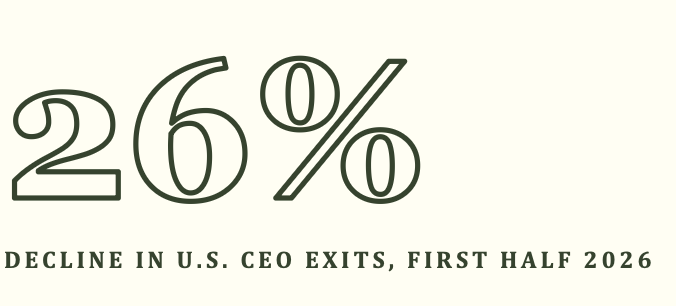
Nationally, CEO exits are down 26% this year — 920 in the first half of 2026, against 1,235 over the same period last year,⁴ representing a change in direction for many boards looking to hold onto the leaders they have, rather than reaching for a new potential candidate that may bring additional risk. The past two years of elevated turnover have settled, moving the priority towards stability.
That sounds like calm. For anyone hiring at the top, it isn't.
However, this isn't quite the calming of the market that it may look like initially. Instead, the reality looks more like a regional market with rising demand for leadership, sitting inside a national pool that has largely stopped circulating. Fewer seats opening elsewhere means fewer proven operators actively in motion, fewer inbound applicants worth investigating, and a shrinking pool of leaders who are actively looking at exactly the moment Triangle companies need more of them.
While demand is local, supply is national, and in the current market, candidates aren’t willing to take a risk with a new opportunity, and competitive draws for new talent are being reevaluated.
Changing the shape of executive search planning.
Less executive movement doesn't just mean fewer candidates. It means that the way searches are conducted and planned for must also change: it’s no longer enough to hire any search firm in a panic after and unplanned for exit. Successful leadership placement in the current market requires pre-emptive planning that helps future-proof sudden exits and leveraging a complete view of the talent market to understand competitive advantage.
The market is in a period of slow turnover. When the number of exits is elevated, a large share of executive search is crisis replacement once a seat opens unexpectedly. But when boards hold onto teams already in place, the purpose of executive searches shifts towards future planned successions and change management: when a company knows the transition is coming and has time to get it right.
Most companies see a known transition twelve months out and push off planning until it’s too late. By understanding the current market, anticipating future needs, and preparing teams for transitions ahead of time, organizations and boards get to be selective, not choosing from a short list of picked through candidates.
What that means for Triangle leadership teams.
If a transition is coming to your organization — at the C-level or for a critical functional leader — the work starts now.
In practice, that looks like:
Name the transitions you already know are coming.
Map the market before the seat opens, so a shortlist is ready the day the search launches.
Build real relationships with leaders who are not on the market.
Audit your internal bench and talent pipelines honestly.
Review compensation and role comps against regional and national market realities before an offer goes out.
None of these tasks are urgent, and they are often the first pieces to get skipped. But the organizations prepping for future change and laying the groundwork with a leader in the seat, have the edge on identifying the ideal talent.
The market rewards preparation right now, not reaction. In a national environment where the best leaders aren't going anywhere, the advantage goes to the organizations that started the conversation early — and to the ones who understand that the strongest candidate for a role in 2027 has no idea they're a candidate yet.
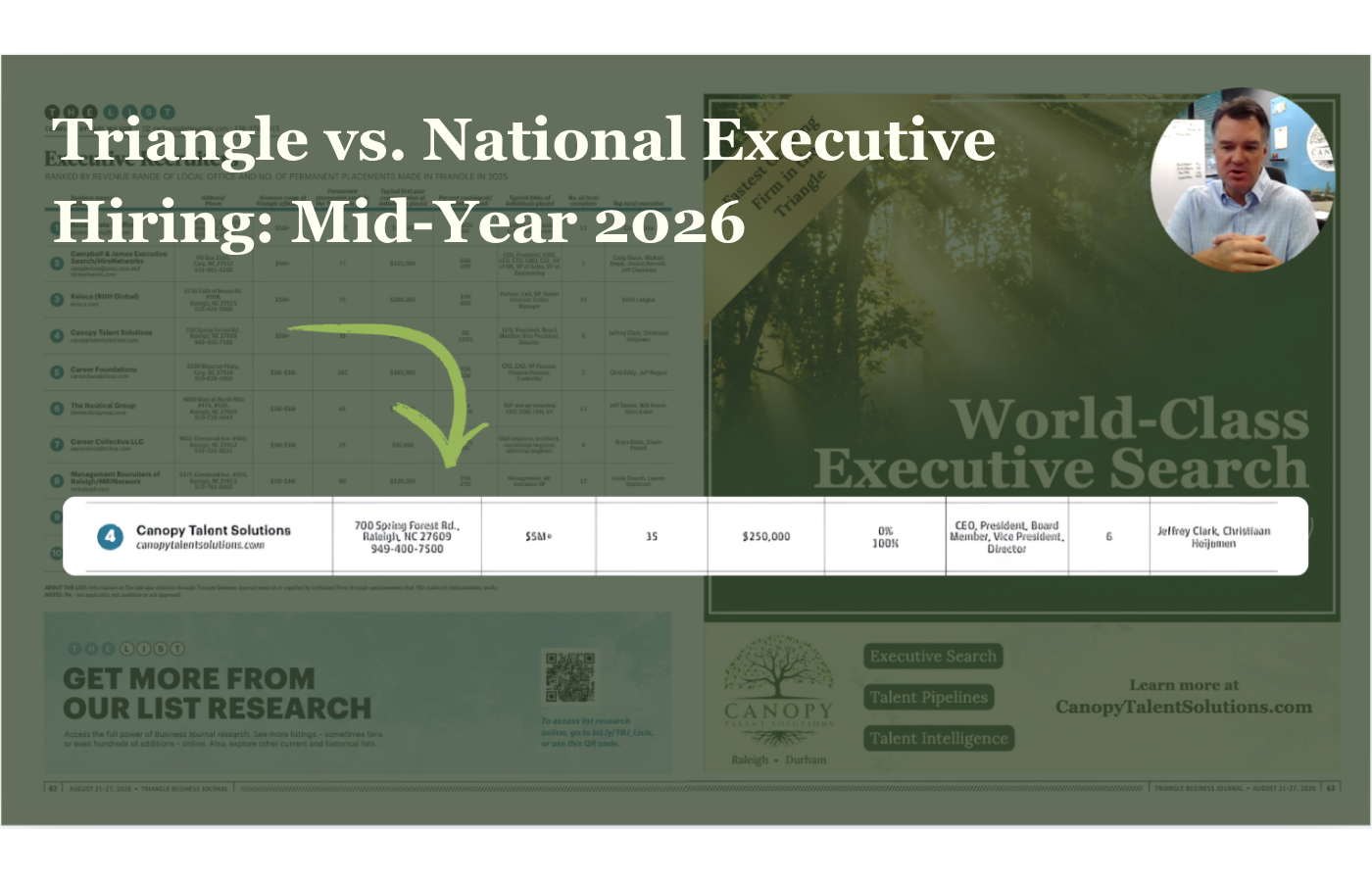
Finally, our team was thrilled to be included in the Triangle Business Journal's annual list of the Triangle's biggest executive recruiters.⁶ A great way to close out a busy summer, and our thanks to the team at TBJ.
Learn more about how Canopy Talent Solutions builds executive search around your transition timeline, not the market's.
-
1. U.S. Bureau of Labor Statistics, Employment Situation — July 2026 (released August 7, 2026); consensus forecast per Dow Jones, as reported by CNBC. cnbc.com/2026/08/07/jobs-report-july-2026.html
2. Axios Raleigh, “Raleigh’s economy is posting strong job gains so far this year,” July 15, 2026. axios.com/local/raleigh/2026/07/15/raleigh-economy-keeps-on-ticking
3. U.S. Bureau of Labor Statistics, “Employment up in 10 large metro areas, down in 2, over year ended June 2026.” bls.gov/opub/ted/2026
4. Challenger, Gray & Christmas, “June CEO exits ease to 138; First-half 2026 runs 26% below last year.” challengergray.com/blog
5. Canopy Talent Solutions, “The Triangle Talent Paradox: Why Executive Hiring is Booming While the Nation Treads Water,” May 2026. canopytalentsolutions.com/insights/triangletalentparadox
6. Triangle Business Journal, “Here are the Triangle’s biggest executive recruiters,” August 21, 2026. bizjournals.com/triangle