
Intentional Succession and Right-Fit Leadership for the Research Triangle
Planning for the next 50 years.
In June 2026, the Research Triangle Foundation’s Board unanimously adopted RTP 3.0 — a 50-year land-use framework and the first reimagining of Research Triangle Park since it was founded in 1959. Six months earlier, that same Board had started work on a different kind of long-range plan: deciding who would have to execute it.
With the upcoming retirement of Scott Levitan, after nine years of transformative leadership in RTP and a more than 45-year career leading prominent urban innovation and university-anchored developments, RTP was looking for someone to step into the role who could compound the research park’s success. The organization he hands over stewards more than 385 companies and 55,000 employees across 7,000 acres, generating roughly $25.1 billion in annual economic value for North Carolina.
The Foundation launched a national search in December 2025, led by Board Chair Barbara Mulkey, and selected Canopy Talent to find the right person for a role of this significance.
“Selecting the right partner for a search of this importance was one of the most consequential decisions our committee made. From the outset, Canopy distinguished itself through its deep knowledge of the Triangle market, thoughtful search strategy, and exceptional attention to detail”
The Role Fit No Existing Category.
Most executive searches begin with a peer list that includes a clear role description, potential company targets that produce the desired profile, an understanding of how a candidate’s experience will transfer to a role, and who may be ready to make a change.
The significance of this position for not only the park and board, but the wider Triangle as a whole, meant that an equal peer group would be impossible to find. The role requires a mix of commercial and real-estate leadership, public-private partnership experience, stakeholder fluency across universities, industry and government, and the patience to execute a plan measured in decades rather than quarters. No single sector produces that combination. A university COO has the institutional scale but rarely the commercial exposure. A real-estate executive has the development capability but may not have the governance instincts, while an economic development leader has the partnership range but not the operating budget.
In addition to the need for inter-sector experience, almost none of the people who had the technical skills to do the job were actively looking to make a change. The bulk of the viable market was passive talent: successfully employed, well compensated, not in the market, and reachable only through direct research and trusted referral.
Designing the Market, Not Simply Searching It
Rather than start from an established shortlist of comparable institutions and candidate profiles, the Canopy team built the candidate market from scratch; mapping ten industry categories against the KPIs and capabilities the Board had defined as non-negotiable.
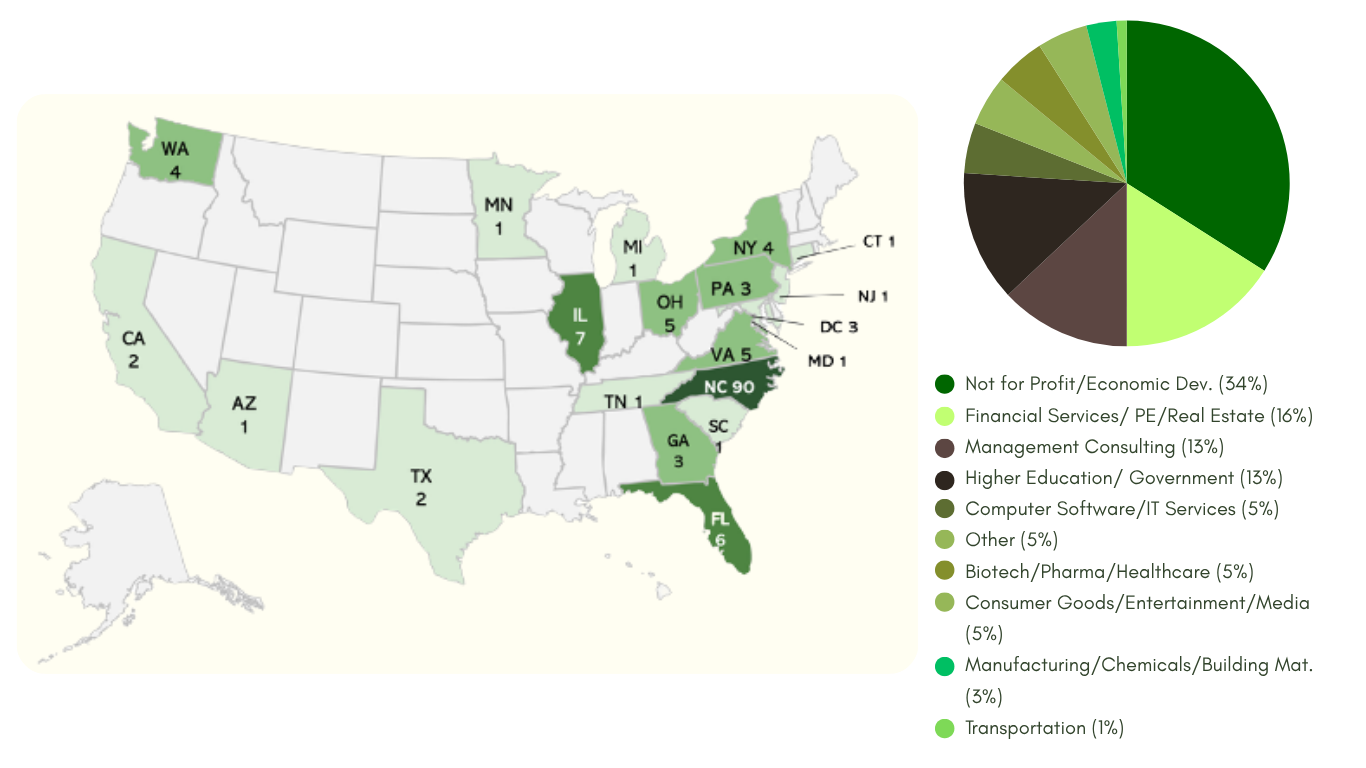
61% of the candidate slate had meaningful ties to North Carolina.
While not-for-profit and economic development made up 34% of the mapped pool, more than two-thirds of the entire pool sat outside of the most obvious sectors to search. The final placed candidate came from higher education and government, consisting of only 13% of the total pool. While most search firms would have stopped at or been limited to the most obvious pool, Canopy was able to provide a view of the entire potential candidate slate.
Ultimately, 61% of the slate presented had meaningful North Carolina ties; a national search that still delivered candidates who understood the state they’d be building in, and inspired trust in the Board for RTP’s future within North Carolina.
Structure, Then Calibration
In order to map a market, the team first had to understand that not every candidate’s resume or experience portfolio would look the same for a role like this. Ensuring that the Board’s required KPIs were met was only one part of the puzzle. In order to successfully select the best candidate slate, we built a process tailored to the needs of the search:
A customized interview framework built against the Foundation’s KPIs and the Board’s stated leadership priorities. This ensured that a university COO and a real-estate executive were assessed on the same capabilities, not on their respective industries.
Multi-stage evaluation where structured interviews, behavioral assessment and finalist evaluation, ran continuously rather than in discrete rounds.
Confidential outreach throughout, because the people worth reaching had current employers and reputations to protect.
Live market calibration and consistent communication delivered to the committee for the duration of the search, not just from the initial market read to help make changes in candidate quality throughout.
“Every stage of the process was deliberate, well-organized, and tailored to the unique needs of Research Triangle Foundation and the future of Research Triangle Park.”
The Incoming President is…
Jonathan C. Pruitt was named the Foundation’s 10th president and CEO, announced July 7, 2026.
Pruitt joins September 15 and works alongside Levitan through an October transition, with the goal for a smooth handoff. His background encompasses multiple sectors, from The University of Texas System, where as executive vice chancellor and COO he oversees finance, operations, real estate and capital planning across nine academic and four health institutions. Before that he spent nearly two decades in the UNC System and at UNC-Chapel Hill, including serving as primary strategic advisor to the System President.
Institutional scale, capital development experience, and deep North Carolina roots. This was the combination for success the Board described in December, and found in a category that wasn’t the obvious one.
What This Search Says About the Triangle
Roles like this one are becoming more common in the Triangle, as it attracts more capital and more complex institutions. The leadership profiles required are increasingly hybrid and inter-disciplinary: people who sit at the intersection of sectors rather than squarely inside one. We wrote about that dynamic in The Triangle Talent Paradox, and this search is a version of it playing out at the highest level.
The implication for anyone hiring at the top: a peer list is a starting assumption, not a search strategy. If the role genuinely has no comparable, the market must be built before it can be evaluated.
Canopy is the executive search partner for organizations in the Triangle and beyond that are looking to redefine their trajectory of success from the top down.